Let’s dive into common compensation practices and how they work for your organization
According to Mercer’s most recent Compensation Policies and Practices report, more than 90% of US and Canada organizations are managing pay with a salary structure. That’s a lot of companies! There are many different structure designs and not all support the same sort of pay management. Let’s take a look at the many different types of pay structures and consider how they might work for various employee populations and organizational cultures.
What is a pay structure?
A pay structure is a tool used to simplify the administration and management of pay ranges for employees and their individual pay rates. A pay structure consists of pay grades for jobs of similar internal and/or external worth. Typically, pay structures are built using external compensation benchmark data, market pricing, and salary surveys, to support the guideline pay level included in the structure.
There are many ways to make pay decisions, and each has a certain set of characteristics. Each approach, when evaluated against your employee population and desired method of pay management, has certain advantages and disadvantages.
Let’s look at a few types of pay structures in a bit more detail.
Market Reference Points
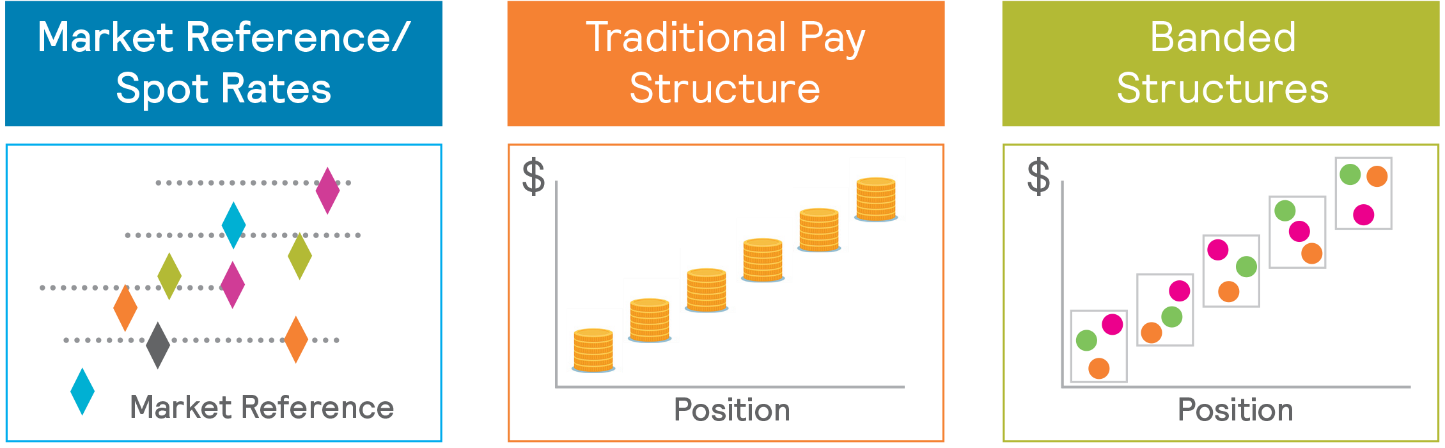
Market reference points, or spot rates, are a type of pay structure where you match every job in your organization to market data that will allow you to develop a market reference point. Within this approach, each job range is discrete and independent, and there is no clear or predetermined progression between pay ranges or within job families. Though less frequently used, this type of system can work well for jobs that are hard to fill, in high demand, or require higher pay and competitive salaries.
In this type of system, you need to update all of the market reference points annually, if not more frequently. This type of system requires a significant amount of market data, benchmarking, and a solid understanding of a wide variety of jobs. The biggest benefit of using market reference points is that the results provide specific pay guidance that can be very beneficial, even necessary, in certain types of organizations.
Traditional Pay Structure
Traditional pay structure is defined as a collection of pay ranges, each with minimum, midpoint, and maximum pay levels. The pay range spread (i.e., the percent difference from minimum to maximum) typically is wide, ranging from a 40% spread up to a 60% spread. The midpoint pay progression (i.e., the percent difference between the midpoint in a range and the midpoint associated with a range one level higher) typically is a progression ranging from 10% up to 20%, with the wider percentages being used for the higher valued jobs in the organization.
Some have come to expect that even a traditional structure is somewhat more varied in range spread distribution, perhaps with ranges going from 30% to 100%, to accommodate the full organization, from the entry-level jobs up through executive-level positions. A traditional structure tends to have 10 to 30 pay ranges, with jobs aligned to each range in a hierarchical manner. You would not typically have overlap of jobs within a career path in one range.
This type of structure largely supports pay progression through the attainment of jobs in higher pay ranges. Notably, traditional pay structures can have a hierarchy of ranges, all with a pattern of progressing midpoints, and can be used to manage salaried or hourly pay; however, for an hourly employee, this approach is less common.
Broad band pay structure
Broad bands, or a banded pay structure, is best suited to an organization looking to emphasize career development for roles that change less frequently and/or provide varying levels of contribution to the organization. Promotions tend to be tied to a major role change, rather than doing more of the same type of work, perhaps a little differently.
The pay bands, or ranges, typically have a width of 100% up to 200%, and are often organized by career level (e.g., professional, manager, executive). Broad pay bands allow for the greatest level of flexibility in managing pay, which has advantages and disadvantages. Organizations can experience challenges with broad bands because of the flexibility. Managers will always play a role in making pay management decisions, and asking them to function with such broad guardrails can cause frustration. Managers typically want to understand what the “market rate” is for a job and that is not readily apparent in a banded pay structure. This leads us to the next type of pay structure, bands with market reference points.
Bands with Reference Points
Originally born out of a need for more guidance and more tools to assist pay decision makers (i.e., supervisors and managers) in considering pay changes for their employees, organizations that have implemented banded pay structures will often now use reference points, or mini ranges, within the pay bands. These reference points provide a clear view as to where individual jobs align along the pay band.
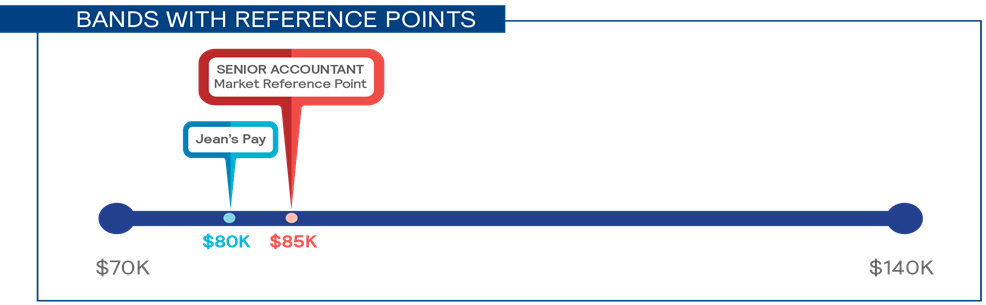
For example, Senior Accountant may be a job that’s assigned to a professional pay band that has a minimum salary of $70,000 and a maximum of $140,000. The current employee, let’s call her Jean, makes $80,000. When Jean’s manager is considering whether Jean is eligible for a raise, he or she needs to understand how Jean’s pay compares to the competitive market rate. It’s helpful for Jean’s manager to know that the market reference point for this Senior Accountant job is $85,000, which represents the pay rate of a fully proficient employee with solid performance in the job. With such utilization of pay bands, Jean’s manager can decide, based on Jean’s performance and how her pay compares to market value, whether a pay raise is warranted.
Although there are very few practical differences between this approach and traditional pay structures, they clearly differ in how positioning is communicated to employees.
Managing pay grades for different employee levels
Executives
Managing pay for the executive population, particularly the “C-suite” (e.g., CEO, CFO), is usually handled differently. Typically, pay for these roles is managed outside of the pay structure, with limited controls. Fundamentally, the highest level of company management has a vast array of experience and qualifications. They bring many different skills to the table and contribute to the overall achievement of the company’s success in a myriad of ways. That creates a need for more flexibility in rewarding executive contributions through pay.
Additionally, in this article, we’ve only been talking about managing base pay, or salary. For the “C-suite,” base pay is not always the most important component of the rewards package. A review of competitive market data suggests that it’s not uncommon for a CEO to have 50% or more of his or her pay delivered via incentives. Given that dynamic, as well as the factors listed previously, the controls put in place by pay are less important at the executive level.
Hourly Employees
For the hourly population, there are several approaches to managing pay. Hourly positions tend to have a narrower degree of pay and role variation within one job. This characteristic means that, though you could create a pay range, as noted above, fixed wage/job rates or step-based wage structures tend to be more efficient from a pay administration standpoint, and more common, for hourly employees.
- Fixed wage / Job rate: A set hourly wage for each job. This approach is common among hourly roles, for which jobs are highly defined, there is limited variation in job responsibilities, and the time-to-proficiency is short.
- Step-based pay structure: A schedule of discrete hourly wages for each job. Pay progression is typically determined by time-in-job, skills obtained, performance, or a combination of these factors. This approach is common in union and non-union environments where experience must be obtained before workers become fully proficient.
Does your Pay Structure Fit?
It’s important to have a pay structure that supports your hiring, promotion strategy, and performance management program, or more simply put, your overall talent strategy.
Trying to operate with a pay structure that is misaligned to your talent strategy can lead to frustrated managers and disengaged employees, not to mention a human resources team that may feel a little beat up! Do you know how well your pay structure is aligned to your talent strategy? Give it some thought by asking yourself these questions:
- Are the majority of our employees within the construct of our pay structure? Except during periods of transition, you want a well-functioning pay structure to contain almost all of your employees (i.e., upwards of 90%). If you have a significant portion of employees outside of your pay ranges, and a lot of exceptions, then your structure is probably in need of some tweaking.
- Do managers struggle to make pay decisions? As an HR professional, you are likely responsible for partnering with managers to make pay decisions for their employees. How does that process work? Can you easily guide managers through the “how and why” of pay increases? Or are there blind spots that take a lot of extra explaining? If the encounters with managers dealing with pay have been consistently frustrating, perhaps this is due to misalignment between the pay structure and talent strategy or company culture.
- Do employees understand how their pay is determined, or how a pay increase is decided? Let’s be honest, everyone wants more pay—with this in mind, simply asking an employee if they are “happy with their pay” seems a bit futile. However, having a pay structure, along with offering an element of pay transparency, might ensure that employees have a clear understanding of how their pay is determined. This transparency could go a long way toward improving your employees’ overall satisfaction with the pay they receive.
These considerations can help organizations determine which pay structure best fits their needs based on factors like role consistency, market demand, and desired flexibility.
Learn more about Mercer’s salary surveys and data
About the author

Andre Rooks, Senior Rewards Consultant
Andre is a Partner at Mercer where he is responsible for developing strategies that improve the outcomes from base pay, incentive pay and other compensation programs.