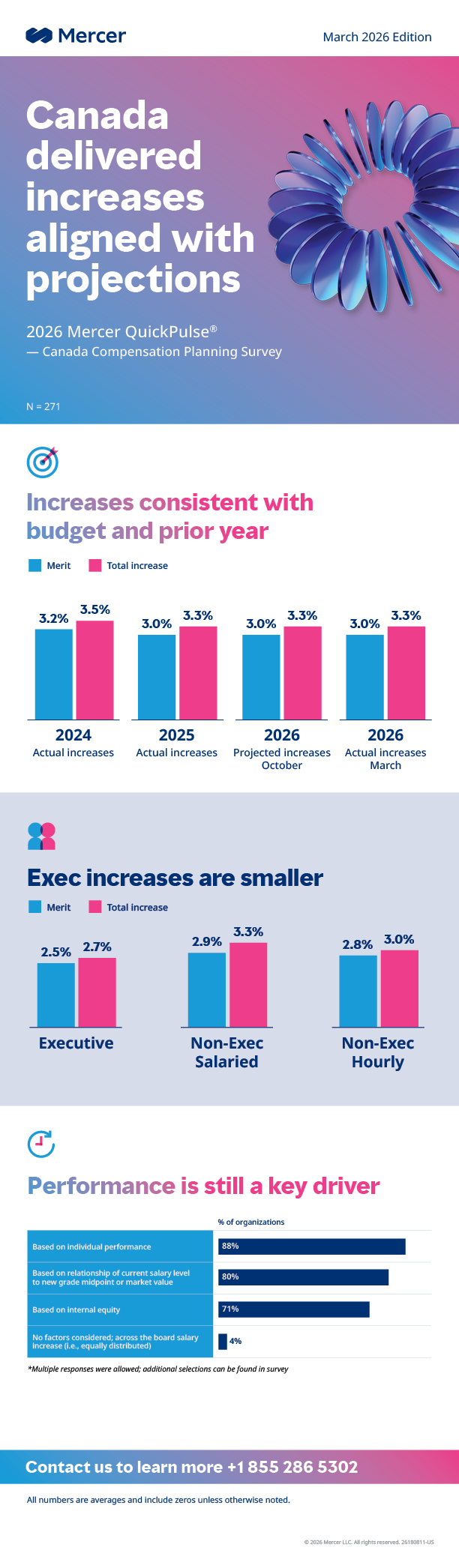
Canadian employers stuck to their projections from October of 2025 when delivering merit pay increases this year. The mean merit increase delivered to employees by the 271 Canadian employers who participated in the March 2026 survey was 3.0%i . Average total increases, including zeros, which includes all types of pay increases in addition to merit, were 3.3%.
Different industries, different increases
While there was not much variety in terms of merit increases actually delivered, there are a couple industries that deviated from the national average. Services (Non-Financial) and Banking & Financial Services both delivered smaller average merit increases, at 2.8%. On the other hand, Life Sciences and Retail & Wholesale both delivered 3.3% merit increases.
Taking a look at total pay increases, several industries went above the national average by delivering more than merit.
- Life Sciences came in at the highest level, delivering 3.8% in total increases
- Banking/Financial Services gave 3.7%, compared to their 2.8% in merit increase, meaning they delivered base pay increases in other ways
- The Retail & Wholesale industries also delivered above the national average for total increases, at 3.6%
Not spreading the ‘peanut butter’
Despite some reporting in the press, it doesn’t appear that Canadian employers are doing flat across-the-board increases (a strategy often called the peanut butter approach, because the company takes the budget and spreads it evenly across employees, regardless of performance or merit).
Only 4% of the Canada Compensation Planning Survey participants said they gave equal, across-the-board salary increases. The majority still use some combination of individual performance, position relative to market value (in one way or another), or internal equity.
Shifting salary structures
It remains true that most Canadian employers are managing employee pay with formal salary structures. As for using geographic differentials:
- 31% of participants do use geographic differentials
- 33% operate in multiple locations but use one national structure
- 34% operate in one or a few locations and only use one structure
Slightly more than half of the survey respondents plan on adjusting their salary structure in 2026 by, on average, 2.7%, excluding those that responded with zeros. This aligns with the typical pattern we see of companies adjusting salary structures annually or biennially and the adjustment being lower than the average merit increase percentage.
We’d like to hear from you
Did you participate in this version of the Mercer QuickPulse® survey? If not, we’d love to hear from you in our next survey. Each year we offer three chances to participate in compensation planning surveys and then an additional three or four surveys on hot topics, encompassing issues that HR pros are dealing with today. By participating you will receive the full results of the survey at no cost to you. Sign up to be notified when the next survey opens.
Here to help
Mercer’s team is here to help you find the right salary surveys, assess your total rewards programs and practices, and serve as an extra team member on a variety of projects. Give us a call at 866-605-1031 or email surveys@mercer.com.
About the author

Rebecca Hall, Principal
Rebecca spent much of her career working in compensation in various corporate roles then transitioning to consulting with Mercer. Her current role, as the Content Leader for imercer.com, allows her to leverage her knowledge of human resources and talent strategy to create materials supporting Mercer’s Products & Services in North America.
iAll averages/means include zeros except if noted otherwise.